
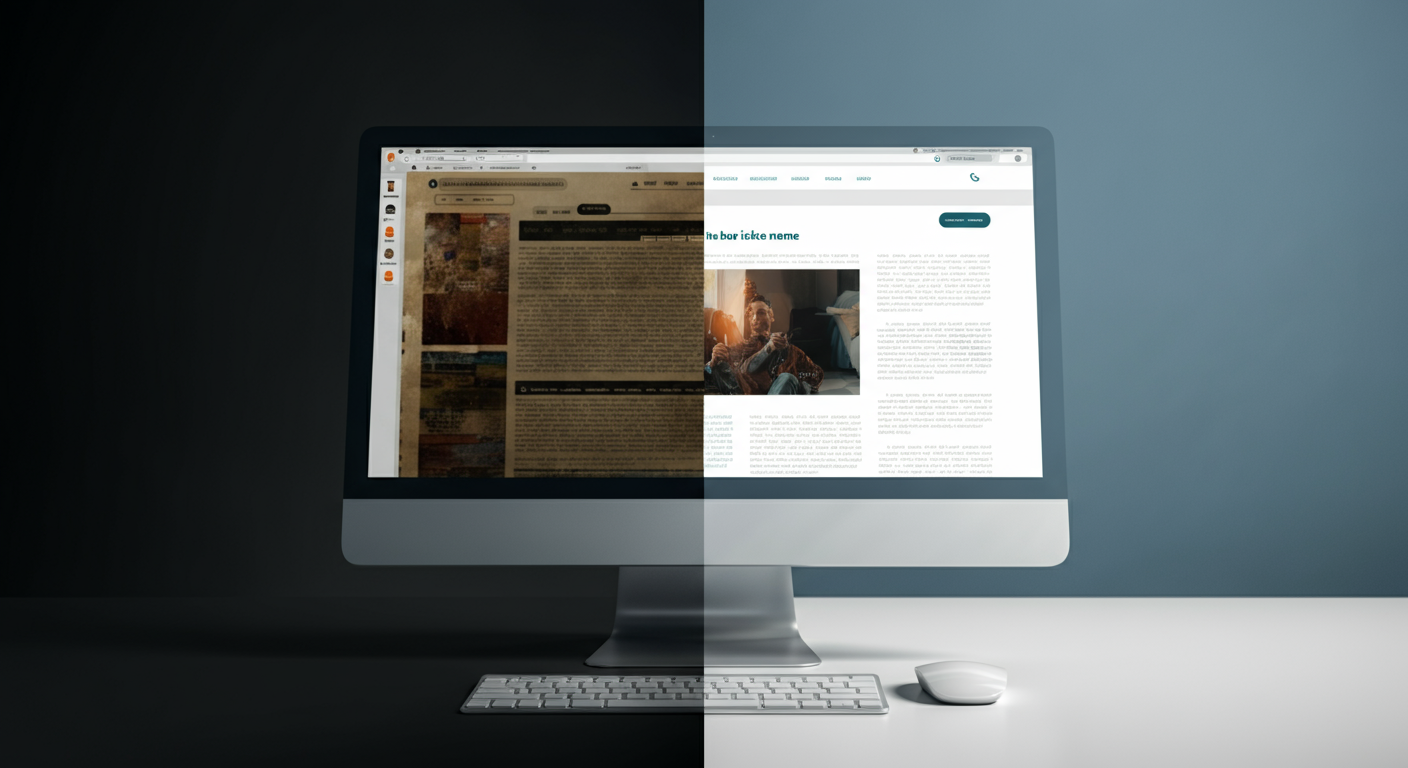
Your website is your most hardworking salesperson — available 24/7, speaking to every potential customer who searches for what you offer. But websites age. Technology evolves, design trends shift, and your business grows in directions your original site was never built to support. The question isn't whether your website will eventually need a redesign. The question is: how do you know when that moment has arrived?
Below are seven clear signs that your website is overdue for a redesign — and guidance on how to tackle the project the right way.
1. Your Design Looks and Feels Outdated
Design trends move fast. A website built five or more years ago can feel like a relic — cluttered layouts, dated typography, stock photos that scream 2015, and colour palettes that no longer resonate. Visitors make snap judgements about credibility within milliseconds of landing on a page, and an outdated design signals that your business may be equally behind the times.
Ask yourself: does your website look as polished and professional as your competitors'? If you find yourself apologising for your site during sales conversations — "our website is a bit old, but..." — that's a strong signal. A modern design isn't about chasing trends for their own sake; it's about communicating trust, competence, and relevance to your audience.
2. It Delivers a Poor Mobile Experience
More than half of all web traffic now comes from mobile devices. If your website wasn't built with a mobile-first approach — or if it was built before responsive design became standard — your mobile visitors are likely experiencing a frustrating, broken version of your site. Tiny text, horizontal scrolling, buttons too small to tap, and images that overflow the screen are all symptoms of a site that hasn't kept pace with how people actually browse.
Beyond user experience, Google uses mobile-first indexing — meaning it primarily evaluates the mobile version of your site when determining search rankings. A poor mobile experience doesn't just frustrate visitors; it actively suppresses your visibility in search results.
3. Your Pages Load Too Slowly
Speed is not a luxury — it's a baseline expectation. Research consistently shows that users abandon pages that take more than three seconds to load, and every additional second of delay reduces conversions further. Slow load times are often the result of unoptimised images, bloated legacy code, outdated hosting infrastructure, or a CMS that has accumulated years of technical debt.
Google's Core Web Vitals — a set of performance metrics that directly influence search rankings — measure things like how quickly your page renders, how soon it becomes interactive, and how stable the layout is as it loads. If your site scores poorly on these metrics, a redesign built on a modern, performance-optimised stack can make a dramatic difference.
4. Your Conversion Rates Are Disappointing
Traffic without conversions is just noise. If visitors are landing on your site but not taking the actions you want — filling out a contact form, making a purchase, booking a call, downloading a resource — your website has a conversion problem. This could stem from unclear calls to action, confusing navigation, a lack of social proof, or a user journey that doesn't guide visitors toward a decision.
A redesign gives you the opportunity to rethink your site's architecture from a conversion-first perspective. Where are users dropping off? What information do they need before they feel confident enough to act? What friction points can be removed? Answering these questions before you redesign — through analytics review, heatmaps, and user research — ensures your new site is built to convert, not just to look good.
5. Updating Your Content Is a Struggle
Your website should be a living asset — easy to update, expand, and evolve as your business changes. If publishing a new blog post requires a developer, if changing a phone number means digging through hard-coded HTML, or if your team avoids updating the site because the CMS is too confusing, your website is working against you rather than for you.
Modern content management systems are designed to empower non-technical teams to manage content confidently. A redesign is the perfect moment to migrate to a CMS that fits your workflow — one where your marketing team can publish, edit, and experiment without bottlenecks. The result is a site that stays fresh, accurate, and relevant without constant developer involvement.
6. Your Website No Longer Reflects Your Brand
Businesses evolve. You may have repositioned your offering, refined your target audience, updated your visual identity, or expanded into new markets since your website was last built. If your site still reflects who you were three years ago rather than who you are today, there's a disconnect that erodes trust and confuses prospects.
Your website should be the clearest, most compelling expression of your brand. The messaging, tone, visuals, and structure should all work together to communicate your unique value proposition to the right audience. If a visitor can't quickly understand what you do, who you serve, and why you're the best choice — your site needs more than a refresh; it needs a rethink.
7. Your SEO Performance Is Suffering
Search engine optimisation is not a one-time task — it's an ongoing discipline that depends heavily on the technical foundation of your website. Outdated sites often lack proper semantic HTML structure, have poor heading hierarchies, missing meta data, no schema markup, and slow performance — all of which drag down your rankings. If your organic traffic has been declining or stagnating despite consistent content efforts, your site's technical health may be the culprit.
A well-executed redesign, built with SEO best practices baked in from the start, can dramatically improve your search visibility. This means clean URL structures, fast load times, proper use of heading tags, optimised images with descriptive alt text, and a site architecture that makes it easy for search engines to crawl and index your content.
How to Approach a Website Redesign Project
Recognising that you need a redesign is the first step. Executing it well is another matter entirely. A poorly planned redesign can result in lost rankings, broken functionality, and a site that looks different but performs no better than the one it replaced. Here's how to set your project up for success:
Start with strategy, not aesthetics
Before anyone opens a design tool, define your goals. What does success look like? More leads? Higher conversion rates? Better brand perception? Improved organic traffic? Your goals will shape every decision that follows — from the sitemap to the CMS choice to the visual direction.
Audit what you already have
Not everything on your current site needs to be discarded. Conduct a content audit to identify what's performing well, what can be improved, and what should be retired. Review your analytics to understand which pages drive the most value. Preserve and redirect high-performing URLs to protect your existing SEO equity.
Involve your audience
The best redesigns are informed by real user insight. Talk to your customers. Run surveys. Conduct usability tests on your existing site. Understanding the language your audience uses, the questions they arrive with, and the friction they experience will make your new site far more effective than one designed purely on internal assumptions.
Choose the right technology stack
The platform you build on will determine how easy your site is to maintain, how fast it performs, and how well it scales. Evaluate your CMS options based on your team's technical capabilities, your content complexity, and your long-term growth plans. Don't default to what you used last time — the landscape has changed significantly, and there may be a better fit for where your business is headed.
Plan your launch carefully
A site launch is not the finish line — it's the starting gun. Before going live, set up 301 redirects for any changed URLs, test thoroughly across devices and browsers, configure analytics and conversion tracking, and submit your updated sitemap to Google Search Console. Plan for a post-launch monitoring period to catch any issues quickly and iterate based on real user behaviour.
The Bottom Line
A website redesign is a significant investment — but so is the cost of keeping a site that's actively undermining your business. If you recognise two or more of the signs above, the question is no longer whether to redesign, but how soon you can start. Done thoughtfully, a redesign doesn't just give you a better-looking website; it gives you a more effective business tool — one that attracts the right visitors, earns their trust, and converts them into customers.